
Fergal Parkinson
Published on: January 30, 2023

HLR stands for Home Location Register, which is a database used in mobile networks to store subscriber information. This includes the subscriber’s home network, phone number, and other important details about them. It is used to route calls and texts to the correct mobile network and to authenticate subscribers when they try to access network services.
When a user turns on their mobile device, it registers with the HLR of the network it is currently connected to. This allows the network to route calls and texts to the device in question.
HLR lookups, also known as HLR inquiries or HLR checks, are used to verify the status of a mobile phone number and to retrieve information about the subscriber associated with it.
This can be useful for a variety of purposes, such as verifying that a phone number is valid and in use, and determining the location or network of a mobile phone. This information can also help identify if a customer is active and real, by checking their provided information against the HLR database.
HLR lookups are generally restricted to authorised parties, such as mobile network operators and authorised platforms which have access to trusted global data sources, provided by network operators or government agencies depending on country.
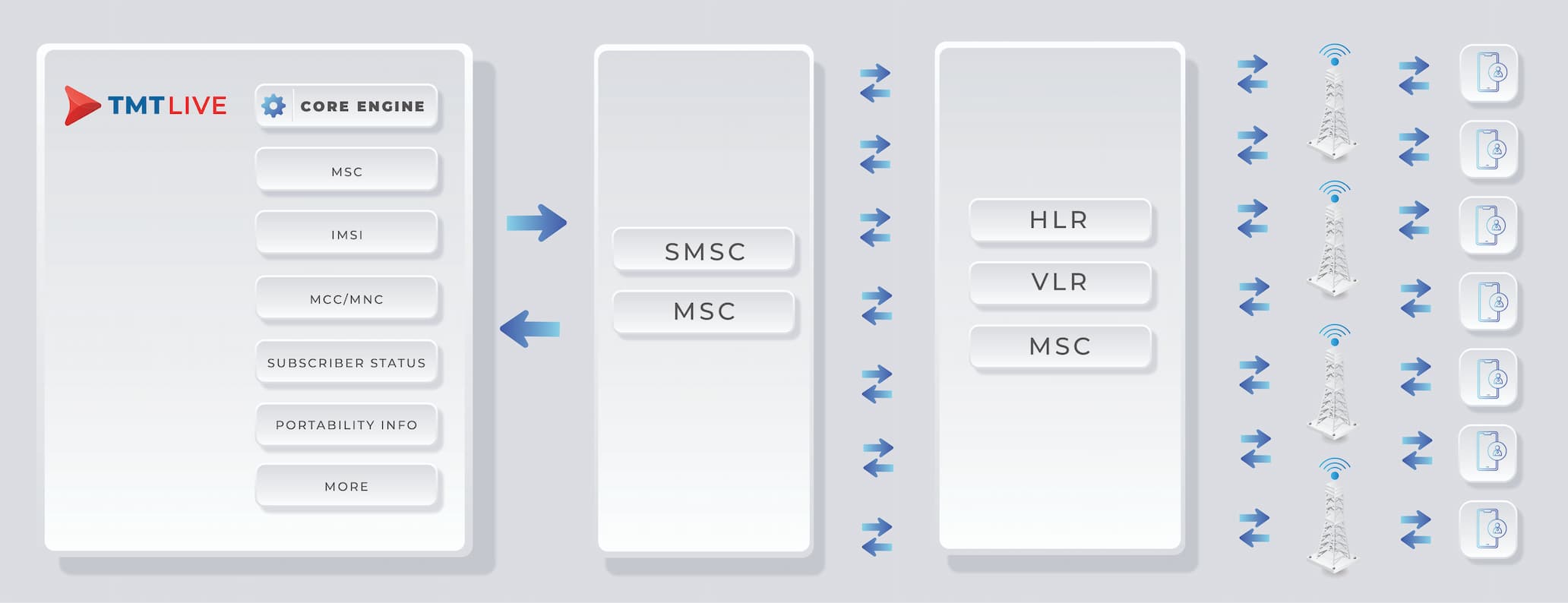
HLR lookups can be used by a wide range of businesses to perform data cleansing on a list of customer mobile phone numbers. This is done by verifying the validity and status of each number before sending out text communications or authorisation codes. This can be useful for identifying and removing invalid or inactive numbers from the list, or for determining the location and network of the mobile phones associated with the numbers.
To perform data cleansing using enterprise HLR lookups, a request is sent to the Home Location Register of the mobile network associated with each phone number in the list. The HLR contains information about all subscribers registered with the network. When the HLR receives the request, it searches its database for the phone number and returns the corresponding subscriber information to the requester.
Using the information returned, it is possible to determine the validity and status of each phone number on the list. Invalid or inactive numbers can be identified and removed, while active numbers can be used for ongoing communications. This has a number of benefits such as reduced costs for sending messages to only active numbers and more accurate customer information.
An active number status check is a process of determining whether a telephone number is currently in service and able to receive calls or messages. HLR lookups can be used to check the active status of a mobile phone number by verifying that the number is registered with a mobile network and can receive calls and texts.
If the HLR returns valid subscriber information for the phone number, it indicates that the number is active and registered with the network. If the HLR does not return any information, or if the data confirms that the number is not registered with the network, it is inactive or invalid.
Undertaking frequent lookups can provide several benefits to a wide range of businesses who handle large amounts of mobile number data. These include:
While HLR lookup services have traditionally been used to validate mobile numbers and retrieve network information, they are fundamentally built on legacy signalling infrastructure and point-in-time data checks.
As digital services increasingly require real-time verification, fraud detection, and instant decisioning, newer solutions such as TMT ID Live extend far beyond what traditional HLR lookups were designed to deliver.
Instead of simply confirming whether a number exists on a network, TMT ID Live provides live, real-time mobile intelligence, enabling businesses to make more informed and immediate decisions.
| Capability | HLR lookup services | TMT ID Live |
|---|---|---|
| Number validation | Confirms if a number is registered on a network | Confirms if a number is active in real time using live network signals |
| Data freshness | Point-in-time snapshot | Real-time network intelligence |
| SIM activity insight | Limited or unavailable | Detects recent network activity and handset engagement signals |
| Number portability | Basic or delayed updates | Reflects current network assignment and porting changes |
| Fraud detection capability | Not designed for fraud use cases | Supports fraud prevention with enriched mobile intelligence signals |
| API performance | Often batch-based or slower queries | High-speed API designed for real-time decisioning |
| Use cases | Basic validation and hygiene checks | Onboarding, authentication, fraud prevention, and transaction integrity |
HLR lookup services remain useful for basic network validation, but they were not designed for today’s requirements around fraud prevention, onboarding speed, and real-time identity verification.
TMT ID Live builds on the foundations of HLR by adding real-time intelligence, enhanced network visibility, and faster decision-making capability, making it more suitable for modern digital ecosystems.
In practice, this means businesses can move from:
This shift is critical for organisations operating in sectors such as financial services, insurance, e-commerce, and communications, where accuracy and speed are both essential.
To provide the most comprehensive cover we can, we use a combination of high-quality HLR providers together with our own Signalling System 7 (SS7) infrastructure. Our support team are constantly testing and optimising this routing to deliver the best mix of performance, coverage and cost.
The costs are variable for a few reasons which relate to the nature of your request. It has become much more flexible to access HLR checks online, which can be undertaken on either a pay-as-you-go basis or as part of a managed subscription, integrated into your existing processes via our Live API. Some other considerations that impact fees include:
There are also a range of checks you can undertake, so unless you’re well versed in these, there can be benefits in working with a managed provider to make sure you’re validating your data in the most optimal way. We’ve published a guide on the different types of number lookup to make sure you’re getting the right information returned.
An HLR lookup works through an API connection by querying a mobile carrier’s HLR database for information about a specific mobile phone number. This query requests information such as whether the phone number is active or inactive, the carrier associated with the number, the roaming status of the number, and the country of origin.
The API connection sends the query to our database, which processes the request and provides a response. Depending on the specific API used, the response may be received in real time or as a batch request.
Our API connection makes it easy for businesses to access real-time mobile phone information in their software. By integrating an HLR lookup API into their own software services, businesses can automatically receive information about mobile phone numbers when needed.
HLR lookups are a very accurate way of determining key attributes about a number, such as whether it is active or roaming. HLR information is both accurate and updated in real time since it is essential for the correct operation of the global telephony network, allowing operators to exchange information on subscriber status to facilitate the completion of calls or delivery of messages. However, HLR cannot be considered as one single homogenous platform, since it is distributed across all of the major mobile operators worldwide. For obvious reasons, these operators will often take measures to limit HLR access for certain countries and use cases, which means that HLR coverage cannot be guaranteed for all operators. TMT ID has a dedicated traffic management team and works with multiple suppliers to ensure that our HLR coverage is as comprehensive as possible.
Businesses employing HLR lookup services must recognise the potential legal and regulatory implications linked with their usage. Depending on the jurisdiction and the specific application, businesses may be obligated to adhere to laws concerning data privacy, telecommunications, and consumer protection. It’s crucial to ensure that the utilisation of HLR lookup services aligns with applicable laws and regulations, including securing consent from individuals whose phone numbers are being queried and safeguarding the confidentiality of any acquired data.
When selecting a provider for HLR lookup services, businesses should consider several factors to ensure they choose a reliable and reputable provider. These include the provider’s reliability and uptime, the speed and responsiveness of their lookup service, and the breadth of their global coverage. Conducting thorough research and obtaining recommendations from trusted sources can help businesses make informed decisions.
There is a good deal of terminology within the HLR lookup sector, so we have outlined the key phrases and abbreviations associated with mobile networks and the Home Location Register database:
Last updated on September 24, 2026