
Fergal Parkinson
Published on: August 27, 2026

Every mobile number carries a history. It is registered with a mobile network operator, tied to a SIM card, used to make calls and send messages, and connected to accounts across banking, retail and social platforms. Used correctly, that history reveals whether a number is real, active and safe to trust, and whether the person presenting it is likely to be who they claim to be and, increasingly more important – not a bot.
That matters because the phone number has quietly become a primary identity credential. TMT ID maintains comprehensive intelligence on approximately 7 billion mobile numbers across every global jurisdiction, facilitating over 200 million real-time verification checks each day for leaders in banking, fintech, identity assurance, e-commerce, and gaming. Most people hold a single number and keep it for years, across house moves, new devices and even longer than changing email addresses. And unlike an email address, which can be created in seconds at no cost, a mobile number is anchored to a commercial relationship with a network operator, which makes it far harder to manipulate at scale.
This guide explains how mobile number intelligence works, the data behind it, how it compares with adjacent approaches such as traditional ID verification checks and biometrics, and how businesses across banking, e-commerce, gaming and messaging use it to make faster, safer decisions.
Safe Customer Mobile Onboarding
Mobile number intelligence allows businesses to identify real customers quickly, protecting against fake account creation and takeover.
Trusted & Reliable Data
A long-term, trusted data point that is collected from reliable sources and is harder to manipulate than traditional sources.
Global Coverage
We offer global, scalable solutions for high-growth businesses across multiple industries.
Frictionless Mobile Number Intelligence in Action
A reliable, future-proof method to improve your fraud prevention checks without adding friction.
Mobile number intelligence workflows operate in three stages: a query, a set of signals, and a decision. The entire round trip completes in the time it takes a customer to move from one screen to the next.
A business submits a phone number through an API at a moment of risk: a sign-up form, a login attempt, a payment, an age check or a large data cleansing exercise. Nothing is asked of the customer. No code is sent, no document is requested, and given how most onboarding workflows include mobile number information these days, no extra step appears in the journey.
The number is checked against two main layers of information. The first is live: real-time queries into global mobile signalling infrastructure that confirm whether the number is valid, active and currently reachable, and on which network. The second is historical: records of how the number has behaved over time, including network movements, traffic patterns and appearances in fraud databases. The next section describes these signal families in detail.
The signals are returned as structured attributes and scores that slot directly into a decision engine, risk platform or in-house rules. Because the response arrives in milliseconds, the check can sit inside onboarding and payment flows without adding any friction the customer can feel. The additional speed and reduced friction make mobile number intelligence a more viable option for high-growth businesses, when compared to other slower and more expensive verification methods.
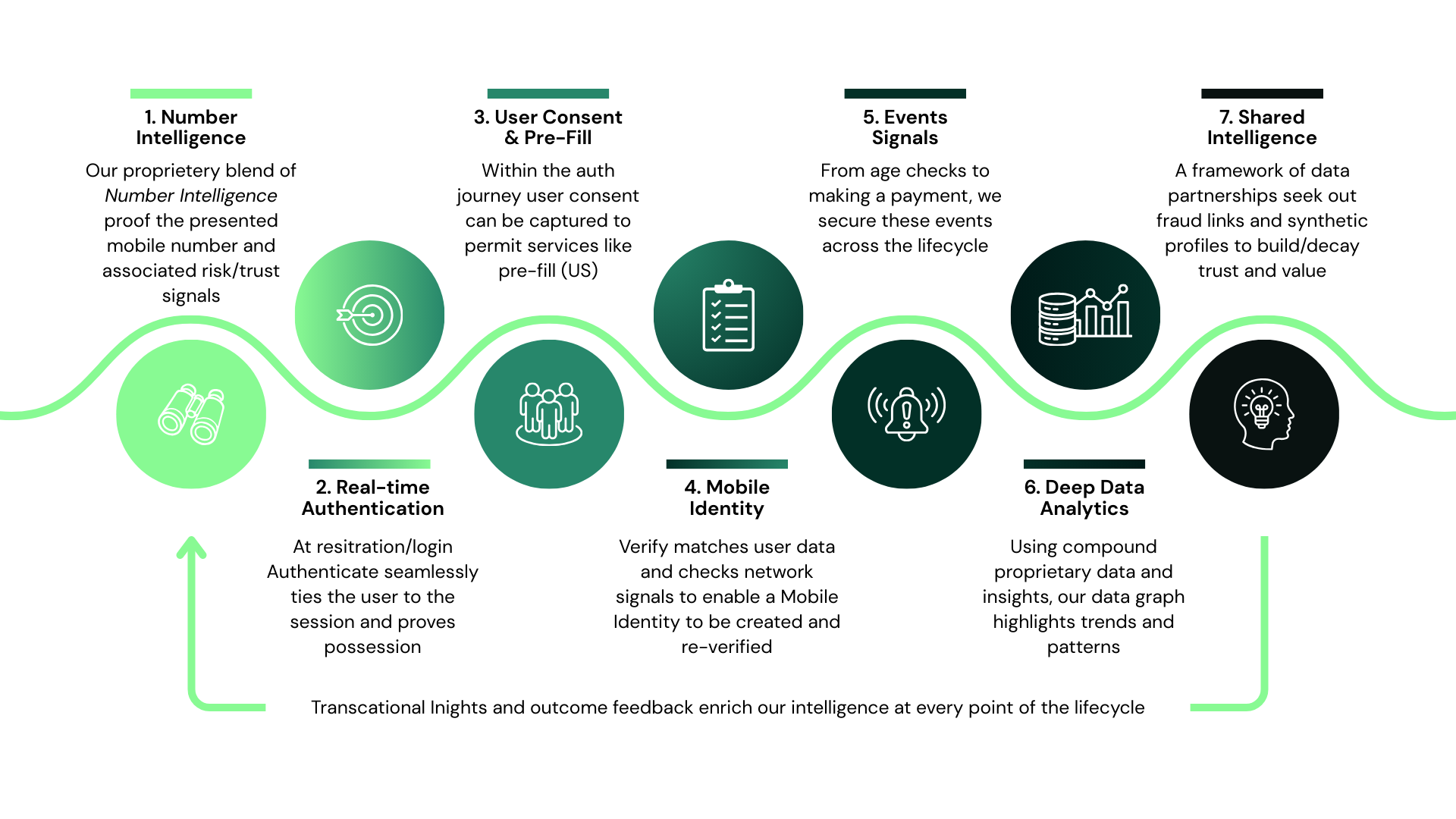
The strength of any mobile number intelligence service rests on the breadth and freshness of the signals underneath it. These are the main groups of data and what each one reveals.
The foundation check: is this number real, correctly formatted to the ITU-T E.164 international numbering plan, currently assigned to a subscriber and reachable right now? A number that has never been issued, or was disconnected months ago, fails at the first hurdle. Our Live number validation service answers exactly this question in real time.
Fraud example: bulk fake account creation typically relies on invalid or recycled numbers that a live status check exposes immediately.
Numbers can move between networks, and a record of those movements is a powerful risk signal. Regulators such as Ofcom require operators to support number portability, so porting itself is routine. Stability is reassuring; a number ported days before a high value transaction is not. Velocity mobile number portability lookups reveal which network genuinely serves a number today.
Fraud example: criminals sometimes port a victim’s number to a SIM they control as a step towards intercepting one-time passcodes.
A SIM swap moves an existing number onto a new SIM card. It can be a routine event when a customer upgrades a handset, but it is also the signature move in account takeover fraud, because whoever holds the SIM receives the security codes. The GSMA’s Open Gateway initiative is standardising network APIs that expose signals of this kind across operators. Knowing that a SIM changed hours before a password reset request is often one of the single most valuable signals in the dataset, and it sits at the heart of our account takeover prevention solution.
A postpaid contract implies a billing relationship, a credit check and a verified address. Prepaid numbers are entirely legitimate, and dominant in many markets, but an anonymous, recently activated prepaid SIM presenting itself for a credit application carries a different risk profile from a ten year old contract number. Context is everything with mobile data as this signal is weighed alongside everything else.
Network level data can indicate whether a number is currently roaming and in which country.
Fraud example: an account registered to a UK address, accessed with a number that has been roaming in a high risk jurisdiction for six months, deserves a closer look before a large transfer is approved.
How often a number appears in connection with calls, messages and verification requests, and how that changes over time, builds a behavioural picture. A normal consumer number has a steady rhythm.
Fraud example: a number attempting sign-ups at dozens of services within an hour is showing the velocity fingerprint of an automated attack.
Some numbers are already known – flagged in industry fraud lists, associated with premium rate abuse, or repeatedly reported for smishing and scam calls. Screening against curated reputation data, as TeleShield does, means one business benefits from what the wider ecosystem has already learned. See our wider telephony fraud prevention solution for how this applies to voice and messaging abuse.
One property ties all of these together – freshness. Numbers are recycled, SIMs are swapped and fraudsters move quickly, so signals decay. This is why live network queries matter more than static databases, and why mobile number intelligence is a real time discipline rather than a batch lookup against yesterday’s data.
Raw signals are useful but combined they become decisive. Mobile number intelligence platforms blend two kinds of data:
In this case, the practical output is usually a score. TMT ID’s Score product, for example, expresses the credibility of a number from 0 to 100, from least to most credible. In practice, we suggest that any score falling under 50 warrants further scrutiny, these cases likely require supplemental verification layers rather than immediate acceptance. A score exceeding 75 provides reasonable assurance of the number’s legitimacy, reflecting a substantive record of both behavioural history and active network presence.
Scores earn their keep at three moments. At onboarding, a low score can route an applicant into enhanced checks while clean applicants sail through. At login, a sudden change in a number’s status can trigger step-up authentication for that session only. At transaction time, a score can be one input among several that decides whether a payment is approved, challenged or declined. The score does not replace a risk policy, it gives the policy more information to make better decisions.
Mobile number intelligence sits alongside several other verification and risk techniques. It replaces some, complements others, and is often strongest in combination.
An HLR (Home Location Register) lookup is a live query that confirms whether a number is valid, active and on which network. It is fast, inexpensive and remains the right tool for jobs like cleaning a contact database or routing messages efficiently, which is what our Live HLR lookup service is built for. Mobile number intelligence builds on the same foundation but layers history, behaviour and scoring on top. A HLR lookup tells you a number is active, while intelligence tells you whether it deserves your trust.
Device fingerprinting profiles the handset or browser, whereas mobile number intelligence profiles the subscriber. A fraudster can buy a new device far more easily than a credible, aged mobile number. The two are complementary as the device tells you what is connecting and the number tells you who.
Document checks, asking a customer to photograph a passport or driving licence, provide strong evidence but at a real cost in friction, abandonment and processing. Mobile number intelligence is invisible to the customer and instant. In a well designed user journey, it acts as the first gate, reserving document checks for the minority of cases where risk genuinely warrants increasing friction. Our Verify product confirms that a number belongs to the person presenting it, without a document upload.
Email addresses and IP addresses carry useful signals, but both are weakly bound to a real person. Email accounts are free and disposable, and IP addresses are shared, dynamic and trivially masked by a VPN. A mobile number’s link to a paid operator relationship makes it a materially stronger anchor for identity.
| Approach | What it checks | Strength | Limitation | Best used for |
|---|---|---|---|---|
| HLR lookup | Number validity, live status, network | Fast, inexpensive, real time | No history, behaviour or risk context | Data cleansing, message and call routing |
| Device fingerprinting | Handset and browser characteristics | Spots device reuse and emulation | Devices are cheap to change | Bot detection, session risk |
| Document verification | Government issued identity documents | Strong evidence of legal identity | High friction, cost and abandonment | Regulated onboarding, escalated cases |
| Email and IP intelligence | Email age and reputation, IP location | Cheap, broad coverage | Weak binding to a real person | Supporting signal in layered checks |
| Mobile number intelligence | Subscriber validity, history, behaviour and risk | Invisible, instant, strongly bound to a person | Depends on breadth of network data | Onboarding, authentication, transaction risk |
New account fraud starts with a form and a phone number. Checking that number before an account exists filters out invalid, unreachable and known bad numbers at the door, and helps satisfy Know Your Customer obligations without adding a single extra step for legitimate applicants. Read more about frictionless digital onboarding and KYC and compliance checks.
The moment a returning customer logs in is the moment a hijacked account does the most damage. Checking for recent SIM swaps or porting events before sending a one-time passcode closes the interception route that account takeover depends on, and triggers step-up checks only when something has genuinely changed. NIST SP 800-63B-4 classifies out-of-band authentication over the public telephone network as a restricted authenticator for exactly this reason. See our login authentication solution and Authenticate product.
High value payments deserve a final look at the credentials behind them. A real time check on the paying customer’s number, its status, and its recent history adds a risk signal to payment authorisation that fraudsters cannot see and cannot easily fake.
Regulation increasingly requires platforms to establish that users are old enough for the content and services they access, with Ofcom setting a highly effective age assurance standard under the Online Safety Act. Mobile number data offers a low-friction contribution to age assurance, using signals available through the operator relationship rather than every user uploading ID documents.
CRMs and databases decay as numbers are abandoned, recycled and reassigned. Regularly screening stored numbers keeps records accurate, cuts wasted messaging spend, avoids contacting a stranger who inherited a customer’s old number, and keeps compliance teams up to date. See our mobile data cleansing solution.
Knowing a number’s current network before sending a message or placing a call means traffic takes the most direct, least expensive route, and undeliverable traffic is stopped before it is billed. Explore SMS and voice call routing.
Banks and financial services. Financial institutions face synthetic identities at onboarding, SIM swap driven account takeover, and authorised push payment scams, now covered by the Payment Systems Regulator’s mandatory reimbursement regime. Number intelligence adds an independent, network sourced signal at each of those points, one a fraudster cannot manufacture with a stolen document. See mobile intelligence for banks and financial services and our APP fraud solution.
E-commerce. Retailers lose margin to promotion abuse, fake accounts and chargeback fraud. Screening numbers at registration and checkout separates first time genuine customers from serial abusers hiding behind fresh email addresses. See mobile number intelligence for e-commerce.
Gaming and gambling. Bonus abuse and multi-accounting depend on creating many identities cheaply. Requiring each account to stand behind a credible mobile number raises the cost of every duplicate, and supports compliance obligations around self-exclusion. See solutions for gaming and gambling operators.
Insurance. Ghost broking and application fraud often leave fingerprints in the contact details – unreachable numbers, recently activated SIMs, one number spread across many policies. Number intelligence surfaces those patterns at quote and claim. See mobile intelligence for insurers and our insurance fraud solution.
Mobile messaging. Messaging businesses contend with artificially inflated traffic and undeliverable volume. Validating numbers before sending messages protects margins and sender reputation. See solutions for mobile messaging providers.
Identity and verification providers. Verification platforms strengthen their own products by adding mobile signals to document and biometric checks, one more independent layer a fraudster has to defeat. See mobile data for identity and verification providers.
TMT ID has built its entire product family around the discipline described in this guide, with each product answering a different question about a number.
| The question | Product |
|---|---|
| Is this number real, active and reachable? | Live |
| Which network serves it, right now? | Velocity |
| Does this number belong to this person? | Verify |
| How credible is this number overall? | Score |
| Is this session still in trusted hands? | Authenticate |
| Does this number show a propensity for fraud? | TeleShield™ |
| Is this user old enough? | Age Assurance |
The fastest way to understand mobile number intelligence is to test it against your own numbers. Request a free demo of our data today.
Building the integration yourself? Start with the developer documentation.
Last updated on September 2, 2026



Learn how live network signals and reputation scoring protect your platform across onboarding, authentication, and transactions.
Reach out today