Zoe Barber
Published on: March 20, 2025
Age verification legislation is advancing rapidly across the world. What was once a voluntary best practice is now a legal obligation in a growing number of jurisdictions, covering everything from social media and online gaming to adult content and e-commerce. This infographic maps the current global landscape — showing which countries have passed legislation and which have proposals in progress — and sets out the sectors, verification methods and statistics shaping the compliance agenda.
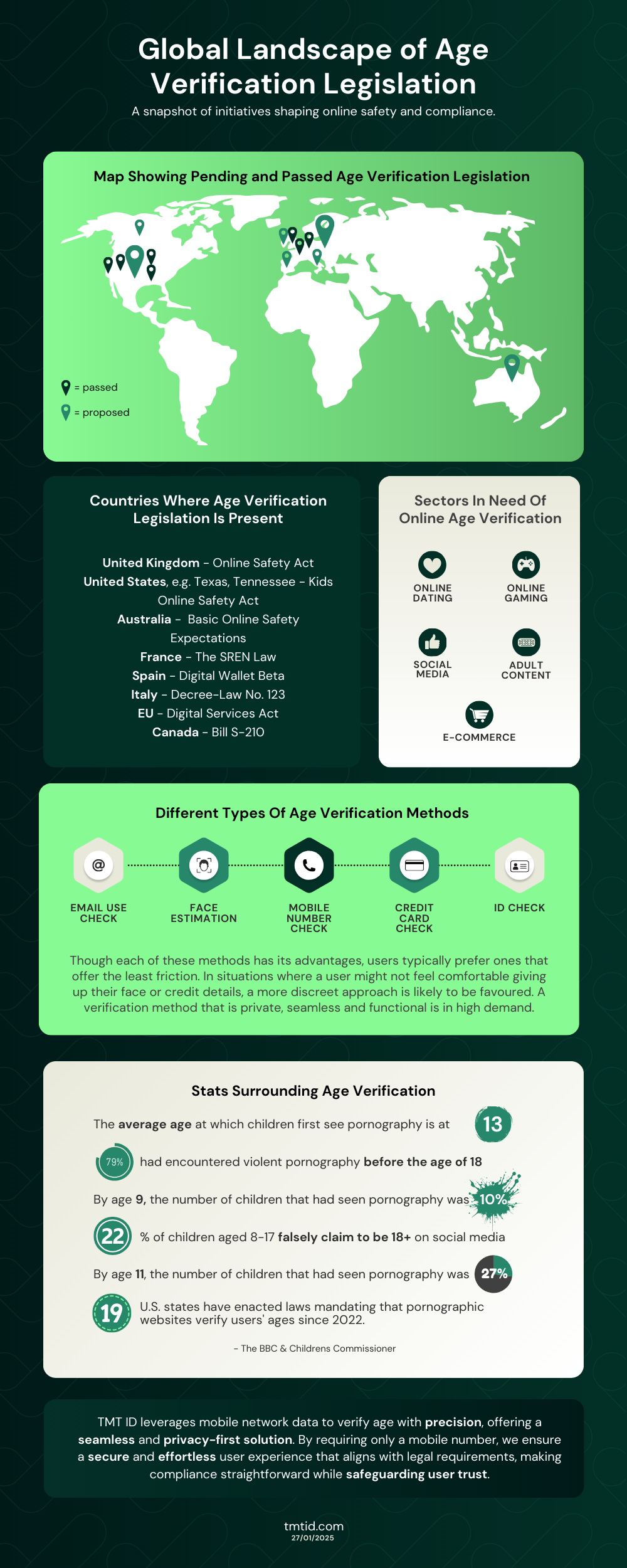
Eight major jurisdictions now have age verification legislation either in force or in active progress:
Regulation is focused on five sectors where the risk of underage access is considered highest: online dating, online gaming, social media, adult content, and e-commerce. Each presents different challenges — adult content sites face the strictest obligations, while social media platforms are under increasing pressure following high-profile cases linking platform use to harm in young people.
Five main methods are currently in use: email verification, facial age estimation, mobile number checks, credit card checks, and ID document checks. Each has advantages but users typically prefer methods that introduce the least friction. In situations where a user might not feel comfortable sharing face data or credit card details, a more discreet approach tends to be favoured. Mobile number verification sits in a strong position here — it is private, seamless and functional, requiring only a phone number rather than a document upload or biometric scan.
The infographic draws on data from the BBC and the Children’s Commissioner to illustrate why legislators are acting with urgency:
These figures explain why a simple “I am over 18” tick box is no longer considered adequate. The gap between self-declaration and verified age is precisely where effective verification technology needs to operate.
TMT ID verifies age using mobile network data — requiring only a phone number to confirm whether a user meets the required age threshold. The check is seamless, privacy-first, and returns a result in milliseconds without asking users to upload documents or submit to facial scanning. This approach aligns with regulatory guidance in the UK, where Ofcom has explicitly named mobile network operator checks as an approved method under the Online Safety Act.
To find out how TMT ID’s age verification solutions can support your compliance obligations, speak to our team or explore our age assurance solutions.
Last updated on June 24, 2026



Age verification should be effortless. We can verify a user’s age and give assurance based on their live mobile account information. Use frictionless age verification which doesn’t require your customers to upload or scan documents
Check out Age Assurance